Why the Genome Is Not a Blueprint, and Why That Trips Up AI
For decades the genome has been described as a blueprint or a program. A closer look at how DNA folds and behaves inside a living cell suggests a messier reality, one that pattern-finding software is not yet built to read.
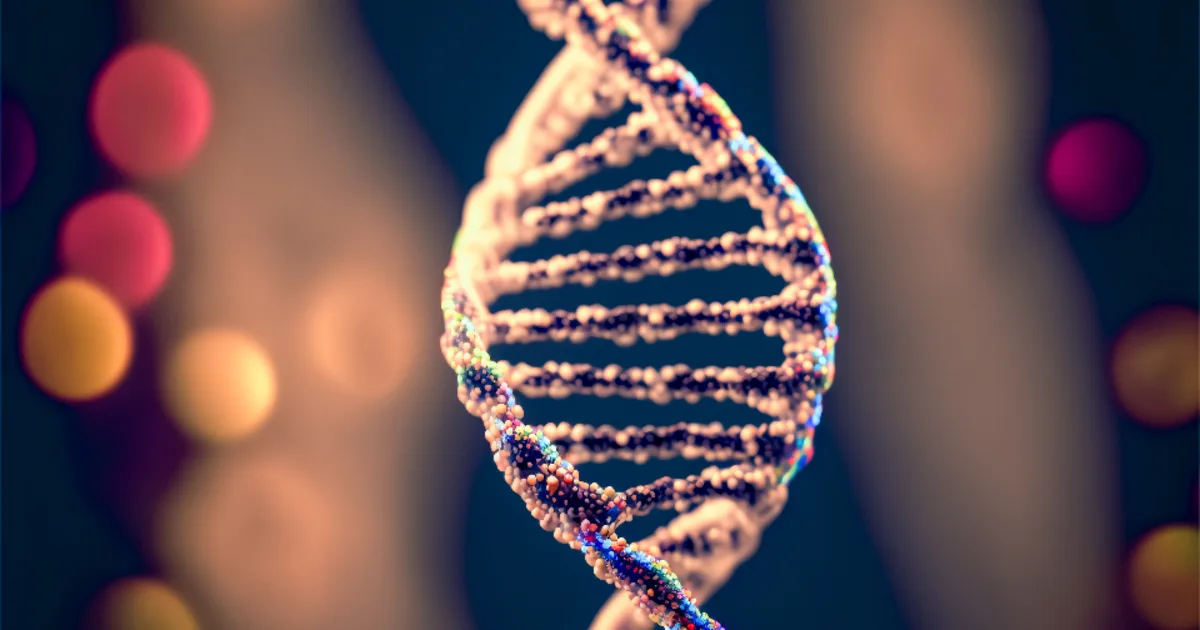
The metaphors we use for the genome have always done quiet work. Call it a blueprint and you imply a fixed plan that a builder follows. Call it a program and you imply code that runs the same way every time. Both pictures have helped students grasp that DNA carries information. Both, a recent line of argument holds, also mislead us about what that information is, and the gap matters now that artificial intelligence is being asked to read the genome at scale.
The starting point is a fact that is easy to state and hard to absorb. The roughly two meters of DNA in a single human cell are folded into a nucleus a few thousandths of a millimeter across. That folding is not incidental packing. Where a stretch of DNA sits in three-dimensional space, which other stretches it touches, and how tightly it is wound all influence whether a gene is switched on or kept silent. The sequence of letters is real, but it is not the whole instruction.
Information that lives in shape
This is where the blueprint image breaks down. A blueprint is flat and complete: every line means the same thing wherever you stand. The genome is closer to an origami sheet whose folds change what each crease does. Reporting in Quanta Magazine describes a growing view among biologists that our genetic heritage is neither a blueprint nor an algorithm but something else, a physical system whose behavior depends on context that the letters alone do not record.
Consider a control sequence that boosts a nearby gene. Read on the page, it looks like a label sitting next to the gene it affects. In the folded nucleus, the same sequence may loop across a large distance to act on a different gene entirely, while the gene it appears to sit beside is governed by something far away. The linear text and the working machine do not line up.
Why this is hard for AI
Modern machine learning is, at heart, a search for patterns in data. Give a model enough labeled examples and it will find statistical regularities that let it predict, with useful accuracy, what tends to follow what. That approach has produced real advances in biology, including in the prediction of protein structure, a subject we cover separately.
But pattern-finding has a built-in assumption: that the signal you want is present, somewhere, in the data you feed it. If a gene's behavior depends on a three-dimensional contact that is not captured in the sequence, no amount of reading the sequence will reveal it. The model is not failing to try hard enough. It is being shown a flattened version of a problem that is not flat. This is a different limitation from the ones usually discussed with AI, such as bias or scale. It is a question of whether the relevant information is in the input at all.
What would actually help
The path forward is not to abandon computation but to give it richer inputs. Techniques that measure which parts of the genome physically touch each other, or that capture the chemical marks layered on top of the DNA, add the missing spatial dimension. Models trained on that combined picture have a chance of learning rules the sequence alone cannot teach. The lesson is less about the limits of AI than about the limits of any method handed an incomplete description.
None of this makes the genome mystical. It is a physical object obeying ordinary chemistry and physics. But it is a reminder that the words we reach for shape the questions we ask. A blueprint invites you to read top to bottom. A folded, living structure asks you to consider where every part sits in relation to the rest, which is a harder and more honest question.
Cited Sources
- Wong, Y. "Why the Human Genome’s Tangled Physicality May Confound AI." Quanta Magazine, 18 June 2026. quantamagazine.org
- Lieberman-Aiden, E., et al. "Comprehensive Mapping of Long-Range Interactions Reveals Folding Principles of the Human Genome." Science, vol. 326, no. 5950, 2009, pp. 289–293.
- Allis, C. D., and Jenuwein, T. "The Molecular Hallmarks of Epigenetic Control." Nature Reviews Genetics, vol. 17, 2016, pp. 487–500.